
Text-To-Pokemon
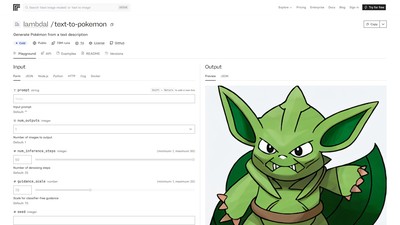
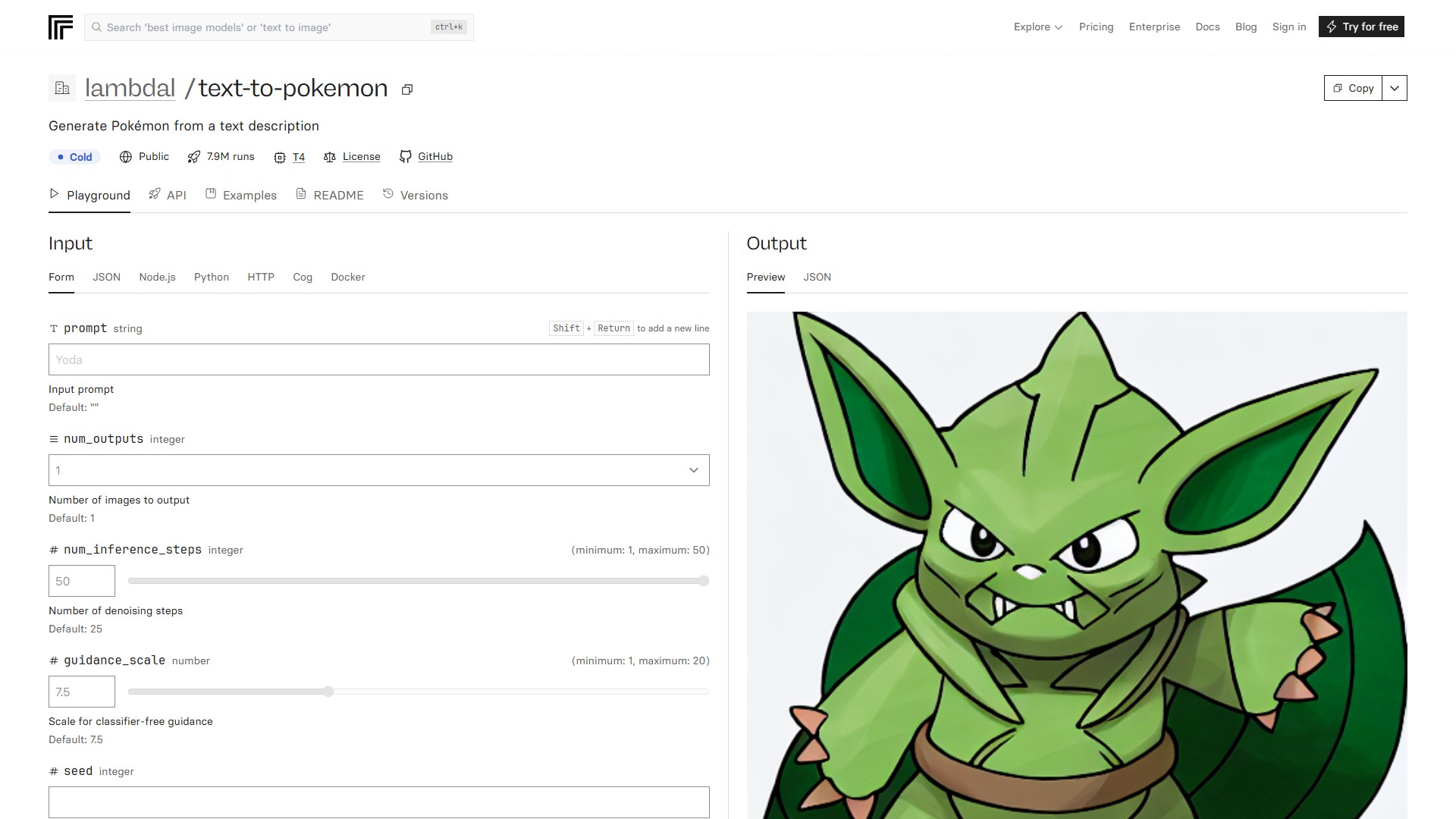
Main Features & Characteristics: Fine-tuned on Stable Diffusion using BLIP captioned Pokémon images, capable of generating Pokémon-style images from text descriptions. No prompt engineering is required to generate characters.
Usage & Input Parameters:
prompt(string): Input prompt, e.g., "Yoda".num_outputs(integer): Number of images to output, options range from 1 to 4, default is 1.num_inference_steps(integer): Number of denoising steps, range 1 to 50, default is 25.guidance_scale(number): Scale for classifier-free guidance, range 1 to 20, default is 7.5.seed(integer): Random seed, leave blank to randomize.
Integration Methods:
- Node.js / Python API: Install the Replicate client library, set the
REPLICATE_API_TOKENenvironment variable, and run the model using the version hashff6cc781634191dd3c49097a615d2fc01b0a8aae31c448e55039a04dcbf36bbato get image URLs or write to disk. - HTTP API: Send a POST request to
https://api.replicate.com/v1/predictionsusing curl. - Cog: Install Cog and use
cog predict r8.im/lambdal/text-to-pokemon@sha256:...to download and run the model locally. - Docker: Run the model in a local GPU environment using the
docker runcommand and call the API.
Target Users & Core Advantages: Aimed at AI art enthusiasts, game developers, and Pokémon fans. Core advantages include specialized fine-tuning for Pokémon style, highly thematic generation results, and support for open-source local deployment.
Pricing & Cost: Runs on Replicate, costing approximately $0.047 per run (around 21 runs per $1). Runs on Nvidia T4 GPU hardware, with predictions typically completing within 4 minutes. The model is open source and can be run for free on local hardware.
Typical Use Cases: Input "Yoda" to generate a Pokémon-style Yoda master image; input "Girl with a pearl earring", "Donald Trump", etc., to generate fun Pokémon-style characters.
Model Background: Trained by Justin Pinkney at Lambda Labs using 2xA6000 GPUs on Lambda GPU Cloud for around 15,000 steps (about 6 hours, at a cost of about $10). Datasets and weights are open-sourced on Hugging Face.
Comment